Expertise
About us
Quantum Sensing – From deep tech to industrial application
While German research institutes conduct globally recognized basic research, the challenge for transformative impact lies in technology transfer: How can scientific excellence be translated into commercially successful applications? How can the latest technologies be made accessible and communicable? That is why a Minimal Viable Product was developed that reduces the complexity of quantum technology to a minimum and directs the focus where it belongs: on the practical benefits of its application.
Use case development
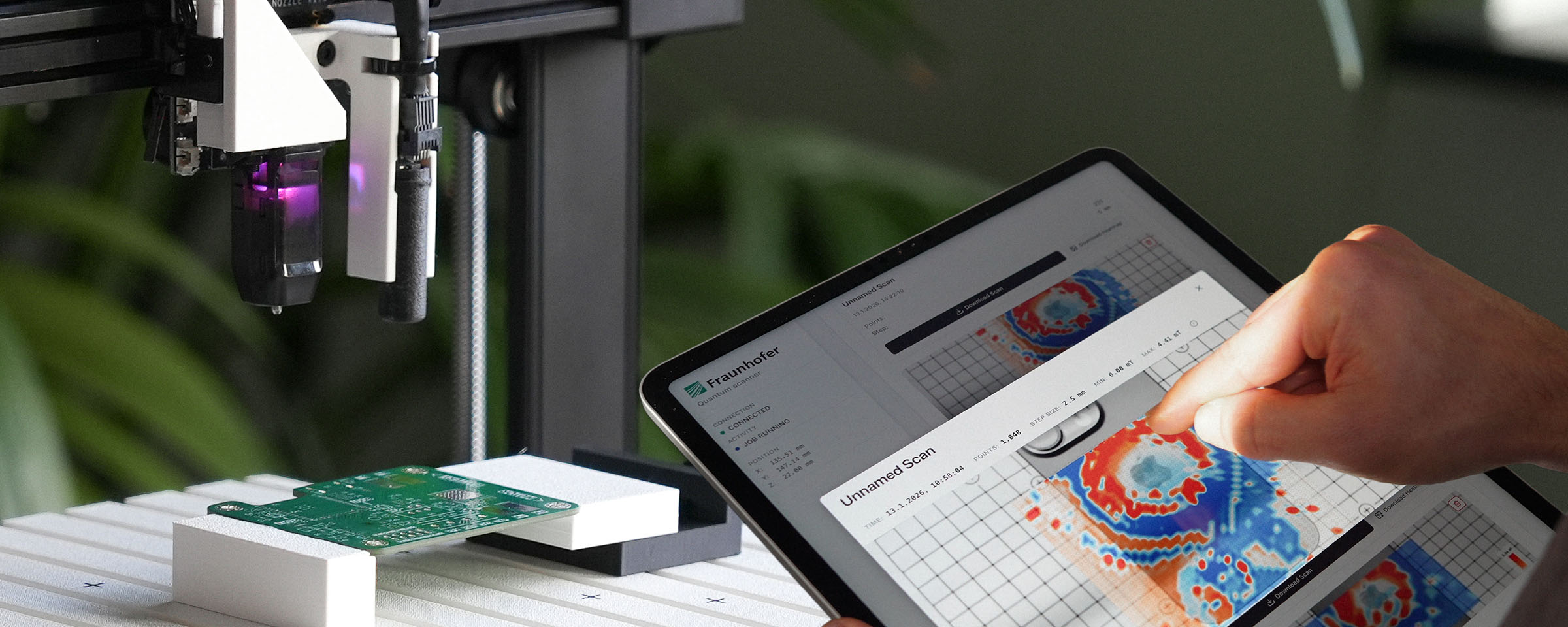
During the project we identified scenarios in which quantum physics solves existing problems and already offers measurable advantages over conventional sensors. This makes new application possibilities tangible. One example is the analysis of complex electronic components: quantum sensing enables extremely high measurement accuracy and the determination of magnetic field alignment. This allows defects in PCBs (Printed Circuit Board) to be detected that would not be detectable without such measurement technology. In practice, this allows circular electronic products to be checked for reuse or refurbishment.
Deep Dive: How quantum physics is becoming a tool
Here's where it gets technical: The heart of the quantum scanner is based on a sensor that uses NV (nitrogen vacancy) centers in diamonds together with a microwave coil to measure magnetic resonance (ODMR).
The NV centers are optically stimulated by a green LED in order to subsequently measure the magnetic field-dependent fluorescence. Without an external magnetic field, a characteristic drop in fluorescence is observed at a microwave frequency of 2.87 GHz. An external magnetic field now causes a symmetrical splitting of this dip into two minima (Zeeman effect). The stronger the field, the further apart these dips move.
The challenge lies in translating this measurement principle into a product form that enables users without in-depth physical knowledge to use it for their specific application, while still allowing them to make the necessary settings and interpret the measured values.
- For users, we have translated the control of the microwave sweeps into a setting for the sensor bandwidth and thus the maximum value for the magnetic field strength.
- For experts, we also record the entire ODMR measurement values in order to display them in a waterfall spectrogram. This visualization of the sweeps enables physicists at Fraunhofer to optimize the measurement parameters and immediately validate the quality of the resonance curves. Furthermore, the sensor parameters, such as the number of measurement points, can be adjusted directly in order to optimize them. For example, sufficient measurements are required to reliably detect overlapping dips caused by the different magnetic field directions without leading to excessively long measurement times.
For the kinematics, we used the gantry (movement system) of an existing 3D printer to position the camera and the quantum sensor. Using a custom mounting system with calibration points, the camera's pixel data is translated into G-code by our backend – this way, the sensor measurement data is stored together with the gantry coordinates and translated into pixel values for mapping the heat map with the camera data.
Functional breakthrough in three weeks
In deep tech development, cycles are often measured in years. Together with the IAO, we have shown that there is another way: from kickoff to functional breakthrough in three weeks. This speed makes it possible to quickly integrate findings from the application into research and to engage in dialogue with industry about their application potential.
Strategic added value for Fraunhofer IAO
Persuasive power of the showcase for potential industry partners:
- Communication through experience: The showcase makes abstract advantages self-explanatory. The IAO no longer just presents research, but solutions.
- Validation of industrial interest: The scanner serves as a “conversation starter.” It provokes real feedback and makes industry partners ask, “How can I use this for my own use cases?”
- Acceleration of technology transfer: The fact that such a showcase can be created within three weeks reduces the perceived risk for potential partners.

„As part of the BMFTR Quanderland project, we are researching new approaches to technology and knowledge transfer in quantum technology. We are collaborating with quantum sensor experts (Dr. André Bülau and Daniela Walter from Hahn-Schickard), identifying fields of application, and implementing next-generation demonstrators. By working with the team at Intuity, we were able to reduce the development time from the initially planned six months to just three weeks.”
DeepTech to Product
The quantum scanner demonstrates that advanced technologies do not require years-long development cycles. By focusing on immediately realizable benefits, basic research can flow into specific product applications at an early stage — making scaling potential transparent. This convinces investors and partners alike, while technology transfer is integrated into commercially viable development from the outset.
Do you have a technology looking for its path to market?